MCQ on Periodicity

Rahul Shaw

 MCQ on Periodicity:-

1) Among the following , the third highest Ionization Energy for-

(a) Mg                           (b) Be

(c) Br                            (d) Al

Ans:- (b) Beryllium


2) Which of the following element has maximum, first ionization potential-

(a) V                                    (b) Ti

(c) Cr                                   (d) Mn

Ans:- (d) Mn


3) Among the following represent correct order of Electron affinity-

(a) Be < B < C < N                (b) Be < N< B < C     

(c) N< C < B < Be                 (d) N<  Be < C < B

Ans (b) Be < N< B < C 


4) If electronegativity of  'x' be 3.2 and the 'y' be 2.2 , the percentage of ionic character of xy bond is---

(a) 19.5        (b) 18.5        (c) 9.5        (d) 29.5

Ans:- (a) 19.5


5) Which oxide of   N is isoelectronic with Co2?

(a)  NO2        (b) NO        (c) N2O      (d) N2O5

Ans (c) N2O


6) The element which exist in liquid state at room temperature is/are-

(a) Na        (b) Br2        (c) Hg        (d) Ga

Ans (b, c)


7) When moving down the group in preodic table from Cl to I , which of the following properties decreases ?

(a) Ionic radius                        

(b) Ionization energy

(c) Oxidizing power                

(d) Electronegativity

Ans (b, c, d)


8) Which is most soluble in water?

(a) Be(OH)2                            (b) Mg(OH)2

(c) Ca(OH)2                            (d) Sr(OH)2

Ans-(d) Sr(OH)2


9) Correct order of Electron affinity is/are--

(a) S> O                                (b) Al> B

(c) Mg> Na                          (d) P> N

Ans- (a , b, d)


10) Among the following , the 1st highest electron affinity  for

(a) F        (b) N        (c) P        (d) O

Ans (a) F


11) Highest covalent character is found in which of the following?

(a) CaF2                            (b) CaCl2

(c) Cal2                             (d) CaBr2

Ans:- (c) Cal2


12) Be is diagonally related to Al because of Similar-

(a) Charge                             

(b)  Electron gain enthalpy

(c) Electronegativity               

(d) Atomic size

Ans-(c) Electronegativity


13) Which of the following is  the Strongest acidic oxide is-

(a) CO2                                (b) N2O5

(c) P2O5                              (d) SiO2

Ans:-(b) N2O5


14) Which atomic number represent a metal is-

(a) 32            (b) 34        (c) 36        (d) 38

Ans:-(d) 38


15) Which  elements represent analogous to the lanthanide's -

(a) Actinides                    (b) Borides

(c) Carbides                     (d) Hydrides

Ans:-(a) Actinides.


practice MCQ on vibration (S.H.M)

Rahul Shaw
This is basis MCQ on the basic of vibration (simple Harmonic motion). Answer of this MCQ given below. 

Practice MCQ ON VIBRATION:-

(1) The potential energy of a particle executing SHM of amplitude a is equal to its kinetic energy when displacement 
of the particle is-
(a) ±a  (b) ± a/2  (c) ±a/4  (d) ±a/√2
Ans-d

(2) If a spring of force constant K is cut into 3 pieces then the force constant of each part is-
(a)3K  (b)1  (c) K  (d)K/3
  Ans-a
Explaination

 (3) The sharpness of a velocity resonance curve is high if the damping constant -
   (a) b is medium 
   (b) b is small 
   (c) ∞ 
   (d)none of these
Ans-b
   
(4)The difference between the phase of the driver and driven system at velocity resonance is-
   (a) π  (b)2π  (c)0  (d) π/2
  Ans-c

 (5) in SHM the force is-
(a) constant force
(b) restoring force
(c) resisting force 
(d) none
Ans-b                                                                                             
  (6) A particle execute SHM, if its velocity is maximum, then displacement will be-
  (a) minimum  
   (b) maximum 
   (c)greater than zero  
   (d)less than zero
Ans-a

 (7) When the frequency (p) of the applied force equals to zero then the velocity amplitude V equals to-
 (a)0  (b)1  (c)∞  (d)0.5
Ans-a

(8) Which of the following is represent logarithmic decrement –
 (a) λ =√bT 
(b)λ=b2T  
 (c) λ =bT 
 (d) λ =bT2
Ans-c

(9) In Lissagous figure, if phase difference between the two waves is π, the shape will be a-
(a) Circle 
(b) ellipse 
(c) straight line 
(d) oblique ellipse
Ans-c

(10)Over damped motion is observed in case of-
(a) Tangent galvanometer 
(b) dead beat galvanometer
(c) Electrical oscillation of LCR circuit 
(d) ballistic galvanometer
Ans-b

(11) If the restoring force constant of a body is 98 Nm-1 , then restoring force of the body for displacement of 10 cm. is -
 (a) 98 N  (b) 9.8 N  (c) 0.98 N  (d) 980 N
Ans-b

(12) For large value of damping constant, the Q-factor 
(a) increases 
(b) decreases 
(c) remains same 
(d) tends to zero
Ans-a

(13) For large value of damping constant, the Q-factor-
(a) increases 
(b) decreases 
(c) remains same 
(d) tends to zero
Ans-b

(14) A particle executing SHM if its amplitude is doubled , then which quantity will be doubled?
(a)time period
(b) total energy
(c) maximum acceleration
(d) minimum velocity
Ans-c

(15) maximum value of velocity in SHM is-
(a) aw  (b) zero (c) aw^2  (d) aw/2
Ans-a

(15) kinetic energy is maximum in SHM at-
(a) at mean position
(b)at extrem position
(c)both mean and extrem position
(d)none
Ans-a

(16) In SHM average value of kinetic and potential energy is-
(a)not equal
(b) equal
(c) average kinetic energy is greater than average potential energy
(d)average potential energy is greater than average kinetic energy
Ans-b

(17) frequency is reciprocal to-
(a) time period
(b) velocity
(c) amplitude
(d) phase difference
Ans-a

(18) Which of the following is force constant unit-
(a) N .m/sec 
(b) N/m 
(c) dyne/m 
(d) None
Ans-b

(19) oscillatory motion are-
(a) bounded motion
(b) non bounded motion
(c) preodic motion 
(d)non preodic motion
Ans-a,c

(20) dimension of force constant (K) is-
(a) ML^2 
(b) MLT^-2 
(c) MT^-2 
(d) ML^2T
Ans-c

(21) Velocity and displacement graph shape is-
(a) straight line
(b) circle 
(c) ellipse
(d) hyperbola
Ans-c

(22) displacement and acceleration graph shape is-
(a) straight line
(b) circle 
(c) ellipse
(d) square
Ans-b

(23)at resonance amplitude is
(a) maximum
(b) minimum
(c)zero
(d) none of these
Ans- a

(24) spring constant depends on-
(a) nature of material
(b) natural length
(c) both of above
(d)none
Ans-c


If you have any dout regarding the answer, please comment in comment box, I will try my best. If you have any questions regarding this TOPIC please give the question in comment box....

           Thanks for coming........

Maxwell equations Based important short notes and formula

Rahul Shaw

Maxwell equations Based all basic important short notes 


TO understand Maxwell equations, first know the some symbol meanings which is used -

*Differential operator  formula is:-
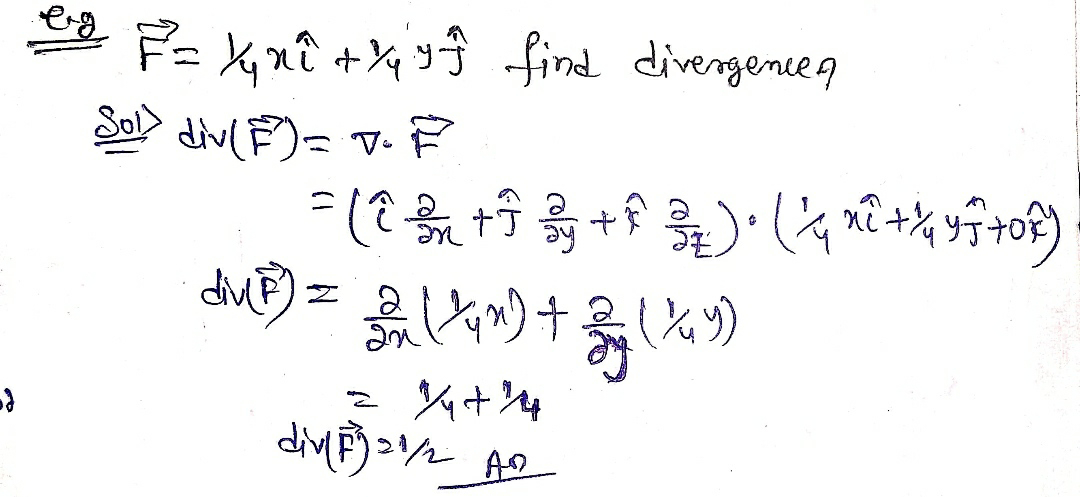
* Vector field Divergence is:-
*How to find divergence of any vector is?
# two basic identity:-

Maxwell equations in differential form-

(1) Divergence of E equal to row by epsilon.(based on GAUSS'S law for Electrostatic)

(2) Divergence of B is equal to zero (GAUSS'S law for magnetistatic)

(3) Curl of E equal to minus of delB by  delt (Faraday law of electro magnetic induction)
(4) Curl of H equal to J + delD by delt . (Amperes circuital law in Modified form)

 MAXWELL EQUATIONS In Integral From:-

Maxwell equations in FREE SPACE:-
In free space conductivity, current density and charge density is zero.

#some important formula's:-

(1)  GAUSS'S divergence theorem Formula is:-

(2) Poisson's equation:- This equation gives the value of potential.

(3) Laplace equations:-

SOME IMPORTANT notes :-

(1) Amperes circuital law is applicable when the current density is  SOLENOIDAL

(2) Work done by Lorentz force 'F' on Charge particle is equal to zero

(3) equations of continuity in steady charge distribution is divergence of 'J' is equal to zero.

(4) total charge in a system is conserved then divergence of 'J'  is equal to -delP/delt.

(5) In conservative field, the line integral is independent of path and curl is zero.

(6) The divergence of curl of a vector is always zero.

(7) vector field is called irrotational if curl of a vector is zero.

(8) the vector 'A' is SOLENOIDAL if divergence of 'A' vector is zero.

(9) in Maxwell second equation (divergence of B is zero) there is magnetic monopole can't exist.

(10) Net surface integral of the vector field pet unit volume is called divergence.

(11)  Two vector divergence is scalars .

(12) Curl of two vector is vector.

(13) scalar magnetic potential exist when value of current density (J vector)  is zero.

(14) vector magnetic potential exist when current density (J vector)  is not zero.

(15) vector magnetic potential curl gives magnetic flux density.

(16) Relation between scalar magnetic potential and vector magnetic potential (A vector) is-


I provide all important short notes and formula on basis of Maxwell equations. 


Simple Harmonic motion (S.H.M) find Time period with Short Trick..

Rahul Shaw

 FIND TIME PERIOD IN S.H.M

Formula of Time period in general is

T=2π√m/k

Here:-

# m=total mass of the system

# k=is force constant

NOTE:- constant force does not alter the time period..


# IF total force is not constant then, use a Short TRICK to find the Total valu of force constant....

   K'= K(Tb/Ts)^2

Here:-

# k' =is total force constant

#Tb=is total Tension of block

#Ts=is totalTension in spring


Numerical:- On the basis of Non-constant force. Find time period.


Find the Time period of pully-based sum..


If this helps you, then please comment in the comment box. So I provide many types of TRICKS to solve numerical.......

                             THANK YOU.......